| Reference |
Stock Item |
|
Description |
|
|
 |
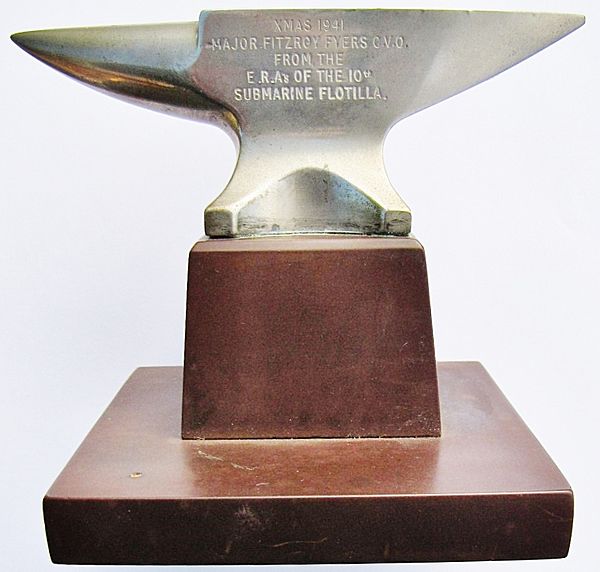
 | 10th Submarine Flotilla Model Anvil with interesting provenance - A fine presentation example fully engraved to front 'Xmas 1941 Major Fitzroy Fyers C.V.O. from the E.R.A's of the 10th Submarine Flotilla.' The CVO represents the Royal Victorian Order instigated by Queen Victoria and was awarded for 'extraordinary, important or personal services to the sovereign of the Royal Family' and Fyer was awarded Commander rank. The 10th submarine Flotilla was known as "The Fighting Tenth" after its tenacious fighting spirit and the heavy losses it suffered. The Flotilla operated from Malta from 1941-43, and despite ceaseless and furiously mounted air bombardment, constantly attacked the Axis convoys all the way from the Italian mainland to North Africa. Clearly this model anvil was presented by the Engine Room Artificers who were essentially Royal Navy fitters, turners or boilermakers, workings on the boats engines and boilers, and trained in the maintenance and operation and uses of all parts of marine engines. Major Fitzroy Fyers pre war was equerry to the Duke of Connaught, son of Queen Victoria, and Governor General of Canada. He attended the 1936 Nazi Party Nuremburg Rally and then a Captain Fyers was one of only two foreign speakers and he delivered his speech in German. In his closing address, the president of the Reichskriegerbund made particularly friendly references to Great Britain! How times subsequently changed! We have no specific provenance as to why Fyers was presented with this unusual gift in December 1941 but assume it must have been during a visit to Malta. The base is we believe made from scrap engine room material (possibly Bakelite) and the model anvil is beautifully crafted. Interestingly the top plate shows evidence of of it being used –perhaps a little extra touched added by the ERA's who fabricated it 73 years ago! Anvil stands 4" high and is 5" wide (9.5 cm x 12 cm.) Certainly a unique item with a wonderful provenance and worthy of further research.
|
|
|
 |
| Marine Caulking Mallet - This example appears to have never been used and is as crisp as when it was made. Constructed in hardwood with metal bands. These mallets were used to hammer oakum into the seams of wooden ships to make the hulls watertight. 41 cm.
|
|
|
 |
| Royal Navy Rum Pump - in copper & brass. Late 19th century, used for drawing daily rum ration from the keg. 101 cm.
|
|
|
 |
| Yacht or Launch Boarding Ladder - Probably made by Davy & Company, London. Manufactured from mahogany and finished in varnish with chrome plated brass fittings. Can be stored folded when not in use and by releasing the hook, can be extended to double its length. While for sale as a collector's item, we believe these steps could be used for their intended purpose although we own a similar set of steps which make a very fine book case in a nautically themed cloakroom! Measures 30.6" x 6" (folded) (77 cm x 16 cm) and 54" (137 cm) extended.
|
|
|
 |
| Yacht or Launch Steps by Simpson Lawrence & Co, Ltd. - This is a small set, probably used to assist crew entering or exiting the cockpit area. The entire unit folds flat when not in use. Fitted with a Simpson Lawrence makers brass plaque with other chrome on brass fittings. Some wear to the original varnish but in generally sound condition. We use a similar example as a book case in a nautically themed cloakroom. Measures 16" x 8.25" (41 cm x 21 cm)
|
|
|
 |
| Ship's Deck Filler Cap - No, this is not a giant's bath plug hole! It is, however, a filler cap and mount, made from solid brass with screw fitted removable cover which is attached with a safety chain to avoid loss whilst at sea. This would probably have been flush fitted to the ship's deck to give access to either diesel or water tanks. The item's diameter is 7.5" (19 cm) and is 3.5" (8 cm) deep. Great for a classic boat restoration project or possibly shore based applications!
|
|
|
 |
| Brass Tiller Yoke with Fitted Pulley Blocks - Superbly cast from solid brass, this would have been fitted to the top of the rudder on a rowing skiff, Admiral's barge or similar. We are unsure as to its date but possibly late 1800's. It makes a decorative nautical artefact in its own right but would also look amazing on an appropriate classic small craft - just the job for Henley! Measures 17" (43 cm)
|
|
|
 |
| SS Atlantis English Pewter Tankard - Atlantis was built by Harland & Wolff and launched in 1913 as Andes for the Royal Mail Line..She operated on the route between Southampton and the River Plate in South America. In WWI she served as an armed merchant cruiser. Post war she resumed service on the South American route but in 1930 she was converted and re named S.S. ATLANTIS with accommodation for 450 passengers. In WWII she was converted and served as hospital ship No.33 and took part evacuating the wounded from the Normandy Beaches as part of Operation Overlord in 1944. Post war she was chartered for 4 years by the New Zealand Government to carry emigrants from the UK to New Zealand until she was finally scrapped at Faslane, Scotland in 1952 after a very full and varied career! Our tankard is a pint capacity and is stamped English Peter as well as carrying the ships name to the front. The tankard is in generally good used condition with some age staining to the metal. We also purchased from same source a further tankard engraved RMS Andes (already sold) and wonder if both were obtained by a long serving crew member ? A fine original souvenir from a fine ship. Measures 4.75" high (12 cm)
|
|
|
 |
| Item 1781 Treen Spill or Pen holder made from timbers ex HMS Iron Duke - Like the letter holder we have also listed today this item carries a brass plaque reading 'Made from Teak of HMS Iron Duke Admiral Jellicoe's Flag Ship Jutland 1916'. HMS Iron Duke was a dreadnought battleship of the Royal Navy, the lead ship of her class, named in honour of Arthur Wellesley, 1st Duke of Wellington. She was built at Portsmouth Dockyard, and launched in 1912. She served with distinction in WWI (including at Jutland.) In WWII she served at Jutland as a Harbour Defence Vessel but was bombed by a German aircraft and had to be beached. She was broken up in 1946 and this spill or pencil holder would date from this time. Finished in polished teak it measures 3.5" high and is 3" in diameter (9 cm high and 5 cm diameter)
|
|
|
 |
| Treen Letter Rack made from timbers ex HMS Iron Duke - An unusual and decorative example with a brass plaque confirming 'Made from Teak of HMS Iron Duke Admiral Jellicoe's Flag Ship Jutland 1916'. HMS Iron Duke was a dreadnought battleship of the Royal Navy, the lead ship of her class, named in honour of Arthur Wellesley, 1st Duke of Wellington. She was built at Portsmouth Dockyard, and launched in 1912. She served with distinction in WWI (including at Jutland.) In WWII she served at Jutland as a Harbour Defence Vessel but was bombed by a German aircraft and had to be beached. She was broken up in 1946 and this letter rack would date from this time. Measures 5"wide x 3.75" tall (12.5 cm wide x 9 cm tall). This actual example was featured in Millers Collectables guide of 2008.
|
|
|
 |
| HMS Rodney Tea Spoon - A Nelson-class battleships and named after Admiral Lord Rodney. The Nelsons were the only British battleship to have 16 inch guns, and the only ones to carry all the main armament forward of the superstructure. Commissioned in 1927, Rodney served extensively in the Mediterranean and Atlantic Ocean during World War II. She played a major role in the sinking of the German battleship Bismarck in May 1941. Like HMS Emerald, Rodney took part in the Normandy landings, including carrying out several coastal bombardments. In poor condition from heavy use and lack of refits, she was scrapped in 1948. We presume our spoon was for a tea caddy or possibly sugar. The top of the stem carries the ships name and crest whilst the reverse is marked EPNS. The spoon shows minor age wear but overall is in excellent condition. Measures 4.5" (10.5 cm)
|
|
|
 |
| HMS Rodney Napkin Ring - A Nelson-class battleships and named after Admiral Lord Rodney. The Nelsons were the only British battleship with 16 inch guns, and the only ones to carry all the main armament forward of the superstructure. Commissioned in 1927, Rodney served extensively in the Mediterranean and Atlantic Ocean during World War II. She played a major role in the sinking of the German battleship Bismarck in May 1941. Like HMS Emerald, Rodney took part in the Normandy landings, including several coastal bombardments. In poor condition from heavy use and lack of refits, she was scrapped in 1948. Our napkin ring carries a fine enamel crest and is named HMS Rodney. The ring is marked EPNS. The silver plate is showing some age wear to the reverse but looks fine when viewed from the front on display. Measures 2" (5.5 cm)
|
|
|
 |
| Royal Navy Cigarette case - This example features a Royal Navy crest to the front with a Kings Crown and fouled anchor below. The engine tuned case if chrome plated and carries an oblong plaque on the front for initials or name to be engraved but this has never been done. The spring catch enables the case to be opened. The interior carries and elastic strap to hold the cigarettes in place (Senor Service of course! and the inside carries a gold effect finish. No makers details od date but believe it dates to WWII. Measures 4.5" x 3.5" (11 cm x 9 cm) Please check out the other military cigarette cases we are also listing today. £28.00
|
|
|
 |
| Royal Navy White Ensign and Flagstaff - We purchased this item from the same Naval family as the Red Ensign which was have also listed today. This is a genuine Naval 'White Duster' which is complete with original coir rope. The flagstaff is made from oak with a varnish finish and would appear to have been reduced in length at some stage. Sadly we have no history with it so are unable to say on what ship it originally came from but judging by its size we suspect a smaller vessel such as an Admiral's barge. The ensign, which is in good clean issued condition, is an ideal display size measuring 35" x 18" (89 cm x 46 cm). The flagstaff is 48" (122 cm)
|
|
|
 |
| Special Forces Canoe Compass Pattern 9628 - Whilst we have had a great variety of naval compasses over the years this is the first dedicated canoe example we have ever seen! This comes complete with its Royal Navy issue deck box marked to the lid 'Delicate Instrument Handle with Great Care', whilst to the front is stencilled 'Canoe Compass Patt 9628'. Inside the box the compass is attached to a cushioned base board and it would appear to have been intended to have been used within the box, which makes sense seeing the very limited space available within a military canoe for instrumentation! The compass, which is finished in matt black paint, is marked 'Serial nos 6916/BHS/214' as well as 'Compass Patt 9228' and a further plaque simply marked TP.The bezel is marked N, E, S, W as well as degrees from 0-360. The bezel can be freed by a locking lever fitted at the 2 o'clock position and can be rotated to indicate a set course and re locked. The compass card swings freely and whilst for sale as a collectable seems to be in good working order. Seeing we have no previous experience of this pattern we can only assume it was intended to be used by SAS and SBS Special Forces canoe sections. The instrument is undated but we feel it is of post WWII issue but we stand to be corrected! Case measures 9" x 9" (23 cm x 23 cm) whilst the compass has a diameter of 5" (13 cm)
|
|
|
 |
| 6 Spoke Teak Bulkhead Ships Wheel and Mount - This one looks exactly as it did when it came out of service! The wheel is made from teak with chromed brass banding and central hub and still fixed to its back plate, drum, wheel mount, spindle and gipsy. This example does not have any makers details but is of a similar design to those made by quality manufacturer Simpson Lawrence. Whilst for sale as a marine collectable the wheel looks to be 100% sound and subject to a full inspection we see no reason why it should not go back to sea. For display purposes in a marine themed room or collection the back board mount can easily be removed. The wheel diameter is 20" (51 cm.)
|
|
|
 |
| HMS Anson George V Class Battleship Wheel - HMS Anson was a King George V class battleship of the Royal Navy, named after Admiral George Anson. Designed to counter the perceived threat from Nazi Germany, five ships of this class were commissioned: HMS King George V, HMS Prince of Wales, HMS Duke of York, HMS Howe and HMS Anson. When her keel was laid down at Swan Hunter, Tyne & Wear in 1937 she was to be called HMS Jellicoe but when launched in 1940 the name was changed to Anson. She displaced 42, 600 tons, was 745 feet long and had a beam of 130 feet. She had a top speed in excess of 27 knots and her main armament was 10 x 14 inch Mk VII guns. HMS Anson was commissioned in 1942 and won Battle Honours in one of the toughest marine environments of WWII, serving in the Arctic 1942-43. Post war, she was the flagship for the 1st Battle Squadron of the British Pacific Fleet and was finally scrapped at Faslane with the surviving ships of her class in 1957/8. This classic six spoke solid teak wheel is engraved on the central brass hub Brown Brothers & Co Ltd Rosebank Edinburgh and is numbered on the reverse 2437. It carries riveted brass banding front and back which has been hand engraved HMS Anson and below the vessel launch date 1940, as well as her Battle Honours Arctic 1942-43. The king post is fitted with a brass thimble to provide a visual indication for the helmsman. The provenance of this wheel is that it was acquired by marine collector extraordinaire Tom Ferrers Walker when Anson was scrapped and was displayed in his collection until his death. It was subsequently purchased directly from his estate and has never been offered on the open market before. Genuine battleship memorabilia hardly every turn up and we are privileged in having acquired this piece of Royal Navy history. Measures 36" diameter (93 cm)
|
|
|
 |
| Name Box from Italian Cruiser Luigi Cadorna - An Italian Condottieri-class light cruiser, which was launched on 30 September 1931 with a crew numbering 507. The ship was named after Italian Field Marshal Luigi Cadorna who was commander in Chief of the Italian Army during World War I. She served with the Regia Marina during Spanish Civil War and in April 1939 she participated in the occupation of Albania. When World War II broke out she was a part of the 4th Cruiser division and saw action in various theatres. On 9th September 1943 she sailed to Malta to surrender to the allies. For the remainder of the war she was used as a transport ship by the Allies and for the repatriation of Italian troops. In 1947 she was one of the few ships to remain in the Italian Navy where she was used as a training ship. After a long and varied career she was finally scrapped in 1951. We have no idea if our box was used on board or the brass plaque was recovered from the cruiser when she was scrapped and made up as a piece of trench art by a crew member. The ships name Cadorna is very finely cut into the brass in a deco style. The box is nicely made in oak and has an opening rear door and measures 12" X 5.5" x 4.5" (31 cm x13.5 cm x11 cm). A most unusual, decorative and scarce souvenir from a capital ship of the Regina Marina.
|
|
|
 |
| Royal Navy White Ensign - A small but beautifully formed example of the Navy's famous 'White Duster'. This is made from applied stitched sections of cotton as opposed to the printed version and comes complete with wood toggle tie and flying line. In excellent issued condition. Measures 35" x 17" (89 cm x 43 cm) so an ideal display size for a nautical collection or themed room.
|
|
|
 |
| HMS Boxer Name Board - Boxer was the very first of the Batch 2 Type 22 frigates of the Royal Navy of the 'Boxer' class. She was built at Yarrow and launched in 1981 and commissioned in December 1983 with pennant number F 92 and at an estimated build cost was £147, 000, 000. Her nickname in service was 'The Billy B' or 'Pinocchio', due to her extended bows. She was decommissioned on 4 August 1999 and expended as a target in the Western Approaches August 2004 after a comparatively short service career. Fortunately her name boards were removed first! This example is one of a pair which would have been mounted on either side of the vessel aft of the bridge. The board is exactly as it was when the ship came out of service and is made from varnished hardwood with a solid brass back plate and heavy hanging points to mount on the ship. The Boxer lettering is in brass and stand proud in relief, picked out in red paint. The board shows the odd sign of service use but is an excellent unrestored example. It measures 37" x 9.5" (92 cm x 23 cm).It also weighs in at a hefty 14.3 kilos so please check delivery costs with us before ordering! A one off chance to own one of the most desirable souvenirs from this fine ship!
|